
Money Matters – Foundations
Overview
Everyone wants to be a millionaire (including me 😂), but like most things in life — and contrary to what we tell kids — you cannot be whatever you want, nor have everything you want. This applies to most people.
What you can do is take some control and set smaller goals to work towards.
In this post my intention is highlighting some of the things I do to be less poor over time - which seems to work mostly 😂.
bag of salt 🧂.
Income
The dreaded J-O-B, yes, yes I know, no one likes this, unfortunately most people need this as this will be your primary income for most, if not all of your working life.
My only advice here is find something you like doing and adjust your lifestyle according to the amount of money you get, having been on the other side as well — being paid more but not really enjoying what I did, was terrible for my mental health and would definitely mean I am poorer over time as I would not be able to carry on doing that job.
Short Term Cash
With short term cash - I am referring to cash you can get your hands on for two different situations:
Unforeseen circumstances
It was a Monday morning, I got into my car started it up, put it in drive and nothing - yes this actually happened, nevertheless, I had access to cash to get this sorted.
Everyday use
Your everyday expense account you use to buy food, petrol etc.
Credit Cards - Cash Fund Accounts - Saving Accounts
Credit cards
I have been a massive fan of credit cards for at least 20 years now and predominantly use my credit card to do all my everyday purchases.
You might be thinking 🤔, why use a credit card at all, with the downside of accruing charges - well this is like a 30 day loan, you can use the banks money to pay for goods now and pay them back later, remember - later is, before they slap on charges.
Savings Accounts and Cash Funds Accounts
I was fortunate enough to have parents that introduced me to the concept of savings from a very young age and have been using savings accounts ever since and still use them up to this day.
A savings account gives you a small yield on the money you are saving, the downside is it probably does not keep track with inflation - as such you end with less money over time as you are paying more for goods every year.
I recently found another type of savings account called a cash fund which invest in cash assets which gives higher yields although also have higher risks compared to savings accounts.
Both of these options do allow you to add money over time and withdraw all the money with some notice.
Mortgage
This is probably the biggest expense most people will make in their lifetime and the thing to allocate extra cash toward so it gets paid off sooner rather than later.
I have tried structuring it this way:
- Take out a loan I can service even if the interest rates doubles without affecting my lifestyle too much, this normally means a smaller loan, thus not that mansion you really want 😂.
- Decide on how much I can save per year to put into the mortgage and fix the mortgage in chunks.
Using simple numbers, it might look like this:
Loan: $500k
Saved per year: $12k
| Term | Amount |
|---|---|
| 1 | $12k |
| 2 | $12k |
| 3 | $12k |
| 4 | $12k |
| 5 | $452k |
This means every year 12k chunks comes up for payment, at year 5 the $452k comes up, you break it up in chunks and you rinse and repeat.
You either use a savings account or a cash account as discussed above to build up that $12k during the year.
Stock Market
Around 2015-ish I became very interested in investing and the stock market. I read a few books and naively thought I was going to be the next Warren Buffett. Well… I am definitely not a billionaire unfortunately 😂.
I’ve tried stock picking by analysing company financials, and I’ve explored quantitative approaches to find an edge. Unfortunately, I’ve come to the conclusion that I’m probably not smart enough — or disciplined enough — to consistently beat the market.
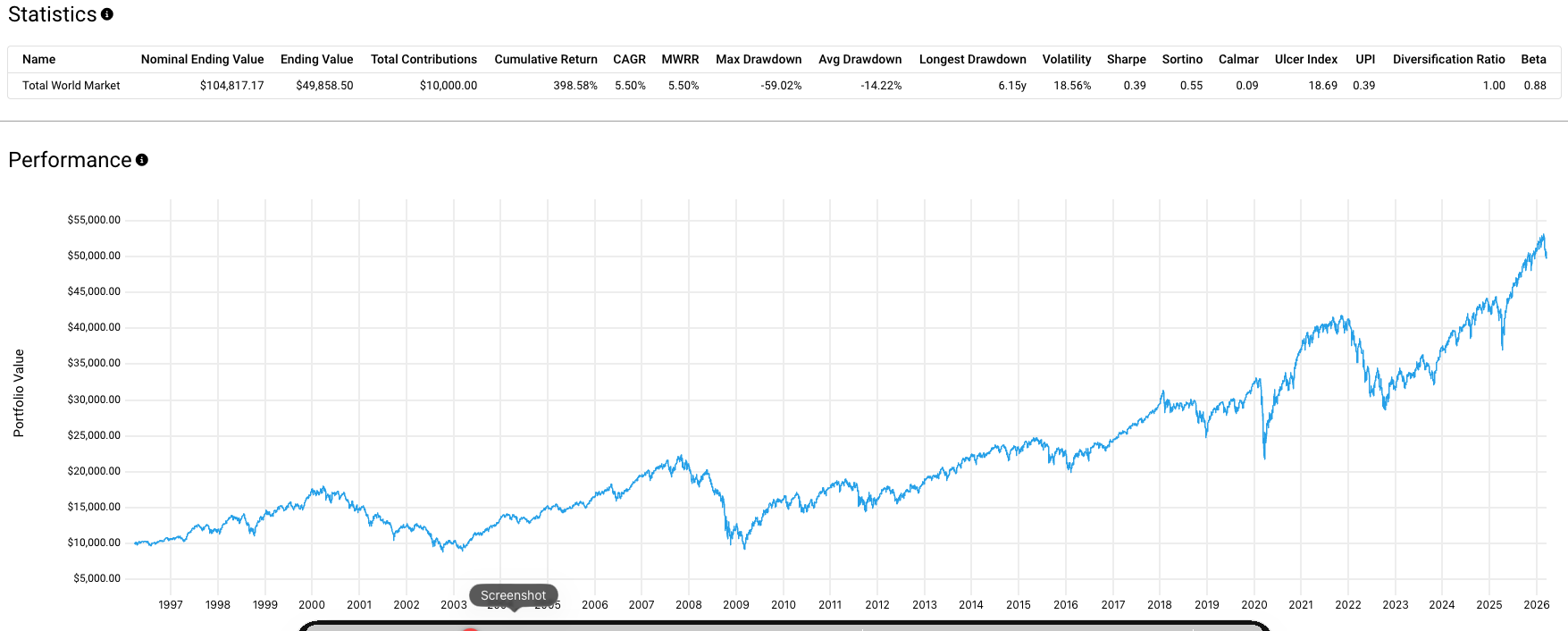
Total World (VT) - Inflation adjusted return
Fortunately, average is not that bad in the stock market — especially considering you don’t have to do much for the extra return, other than live through the drawdowns. A drawdown is one of those nasty dips you can see in the image above — where your portfolio value seems to disappear.
Now you might be saying - yep, those drawdowns is the exact reason I do not mess with the stock market, well - Do you own a KiwiSaver account and is it in a Growth fund? Yes? Congratulations you are exposed to the stock market, and those drawdowns.
My general philosophy is simple: broad diversification, low cost, and long-term consistency. I don’t attempt to time the market — I focus on staying invested.
My current allocations look roughly like this (this is not advice — just what I’m doing):
VTI: 55%
VTI represents the total US stock market. It has performed exceptionally well over the last few years — likely helped by the surge in AI-driven companies.
I think AI will slow down at some point. I have no idea when, but I suspect that some of the companies currently driving returns (NVIDIA, OpenAI, etc.) may eventually face slower growth or valuation compression.
Perhaps then I should rebalance back to a more traditional 60/40 split?
VXUS: 25%
VXUS represents the total international stock market (excluding the US).
I use this primarily for diversification. Since I’m not a superstar investor who can pick global winners, I prefer to own them all.
CEF: 10%
This is my gold allocation. It has performed very well recently — perhaps influenced by geopolitical tension and macro uncertainty.
Benefit
Inflation hedge
Gold’s price tends to move inversely to fiat currency value, particularly the US dollar. When inflation erodes purchasing power, gold demand typically rises.
Market volatility / safe haven
Gold is often less correlated with stocks and bonds. When traditional assets fall, gold can offset losses — either wholly or partially
Economic & geopolitical crises
Gold has historically outperformed during major economic shocks and political instability, making it a reliable store of value during uncertainty
Currency debasement
Gold has maintained purchasing power over thousands of years, unlike fiat currencies.
Risks
No income
It doesn’t generate passive income (no dividends or interest)
TLT: 10%
I use this as a bond allocation for diversification. I might currently be allocating too much — reducing this to 5% is something I’m considering.
Benefit
During recessions or market crashes
Investors flee to bonds for safety.
Risks
Inflation erosion
Traditional fixed-rate bonds (like Series EE) can lose purchasing power if inflation outpaces their interest rate.
BTC
I maintain a very small allocation to Bitcoin. The volatility is extremely high, so I treat this as speculative and monitor it closely.
LINKS
I will include a few links here for services and sites I use.