
Book Review – The Muscle & Strength Pyramid - Training Second Edition
Overview
Reading is something I have a love–hate relationship with. I can go years without reading anything, and then — all of a sudden — boom 💣, I read a ton. Around 2016 I was in a reading streak and even did some book reviews on my then-WordPress site. Unfortunately, I didn’t back that work up properly, so here we go again.
In these book reviews my intention isn’t to write what the book already says word for word — that’s what the book is for, right? Instead, I want to summarize each book in a way that allows me to return to it in a few months or years and grasp the gist without rereading the entire thing. Bonus if it helps someone else too — including the authors!
Enough of the preamble — here is my summary of The Muscle & Strength Pyramid — Training, Second Edition.
The Muscle and Strength Pyramid
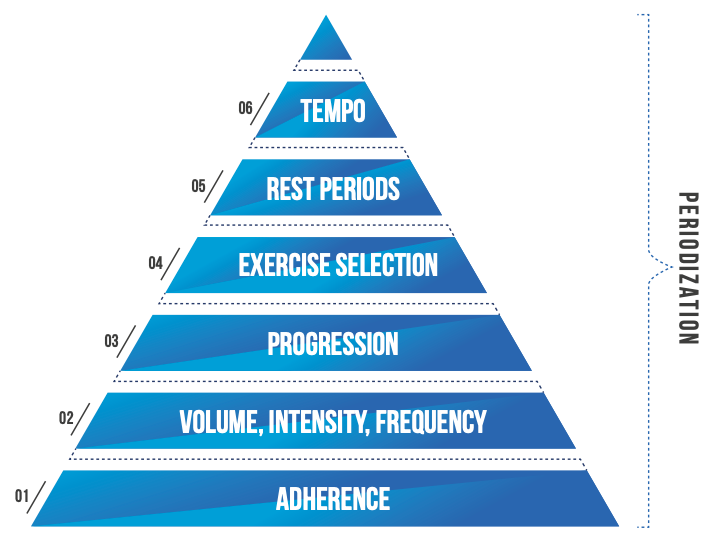
The book’s core idea can be described in a single image, shown below.
Like most things training also suffers from the effect of diminishing returns, which simply states that most of the gains can be gotten by doing 80% of the work.
Level 1: Adherence
Training should be a lifelong goal, now I know what you are thinking, am I going to have to do this until the day I die?
My answer: YES — and you should be excited to be able to choose the activities you participate in, as not everyone is or will be fortunate enough to have that choice.
The authors identifies three conditions for adherence as follows:
Realistic
Is Your Training Schedule Sustainable and Practical?
- Think about timeframes: Is it realistic to think that you can become the next MR Olympia in 6 weeks even though you have never lifted a weight 😂?
- Schedule: Do you have the time to to train this often?
Enjoyable
Can you enjoy training this way for a long period of time?
I’m all for enjoying training — in fact, this should be one of the first things you work on. Make it enjoyable.
However, there will be days when you’re just not feeling it and you’ll dread training. Barring injury or a legitimate reason not to train, we should have the mental discipline to follow through and get it done.
I feel like this isn’t said enough these days — sometimes we have to do things that are uncomfortable or not easy.
Flexible
Do You Have Flexibility in Your Program to Accommodate the Unexpected and Move Forward?
- Having flexibility when life gets in the way: A 7 day a week program does not really leave much flexibility.
Chapter Key Takeaway
Remember, consistency is what makes progress rather than perfection.
Optimal does not equal sustainable — don’t set yourself up for failure.
Level 2: Volume, intensity and frequency
The following chapter is extremely dense and thus I am skipping over tons of content specifically around:
- Strength based training, I am more interested in the hypertrophy aspect 😄.
- The meta analyses research the authors go into to substantiate their recommendation - I highly recommend reading these, this is not a “trust me bro” book.
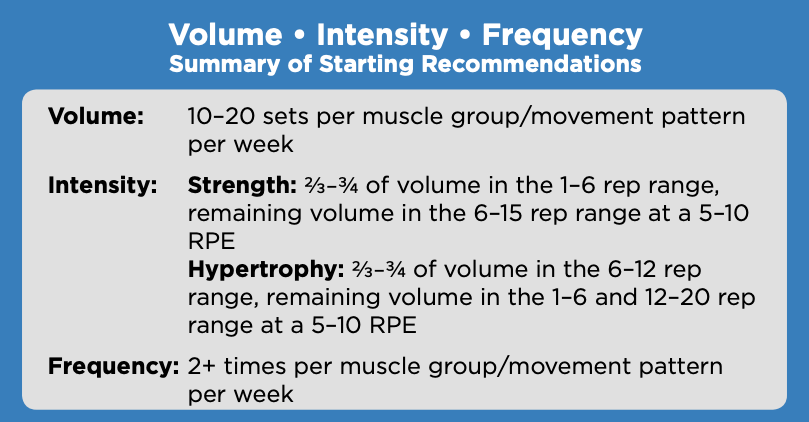
Volume
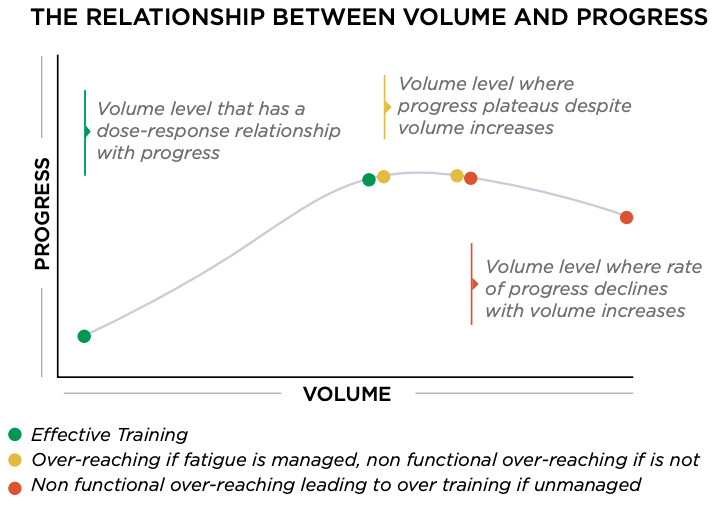
Volume is the total amount of work performed, and to a point, shares a non-linear relationship with adaptation.
It can be counted as ‘volume load’ (sets x reps x load)
The authors do bring up a flaw in this measuring method where lower weight and high reps seem to blow out volume even though it does not realistically contribute that amount to strength nor hypertrophy. The solution they recommend is to track volume for both hypertrophy and strength by counting the number of sets performed in a given intensity zone.
More volume allows for progression of hypertrophy and strength up to a point, where too much volume becomes counterproductive as it eats into your ability to recover, this is a typical U-shape relationship as seen here:
Volume Recommendations:
“Do enough to progress, not as much as possible. Increase when plateaued if you are recovering well.”
Intensity
Intensity can be described as intensity of load or intensity of effort.
Strength training athletes normally use the intensity of load method and measure it as follows:
- Percentage of 1RM(1 rep max) - Estimate what your 1RM is, based on a weight that is lower than your 1RM and using a calculator to calculate 1RM.
- 1RM(1 rep max) - Actually lifting a load for a single rep.
Bodybuilders normally use intensity of effort method and measure it as follows:
- Rating of perceived exertion(RPE) - How many more reps in reserve(RIR) you have before you can not perform another rep with good form, which is a scale where zero means no more reps can be performed with good form. Another popular scale is RPE which is a scale out of ten, thus an RPE of 10 would mean you have zero reps left to perform an exercise with good form.
Intensity Recommendations
Intensity is specific to your goal. Lift heavy for strength, and ensure sets are performed at an adequate effort for size. Remember progressive overload.
Frequency
Frequency just refers to how you split up your volume over multiple sessions and is highly related to how well you recover, if you are lucky and recover quickly then you can technically do more volume. Generally do not do way more than around 12 sets per muscle in a single session.
Frequency Recommendations
Organization matters. It is possible to do too much in a single session. Spread the work over the number of sessions required to accommodate volume.
Chapter Key Takeaway
Level 3: Progressions
The audience for this chapter will not be the novice or early stage intermediate lifter, as the authors note; following the previous chapters advice should suffice until they get well into the intermediate stage. As such this chapter is concerned with what other tricks do we need, to reach for, to still progress.
Volume May Need to Increase Over Your Training Career
The closer you are to your genetic limit the more volume do you need to introduce to make progress.
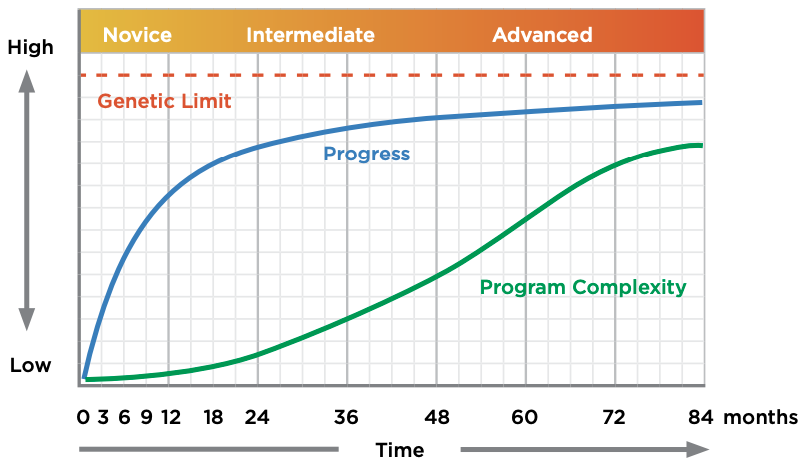
Increased strength is a sign that you are providing an adequate overload for hypertrophy.
If you are gaining strength on most of your movements, that’s a good sign that you are providing adequate overload.
How Quickly Can We Gain Strength?
Deloads
Deloads are simply a reduction of volume and/or intensity for a week or so to allow fatigue to drop. The authors suggests this is a great way to keep on making progress and lower the risk injury.
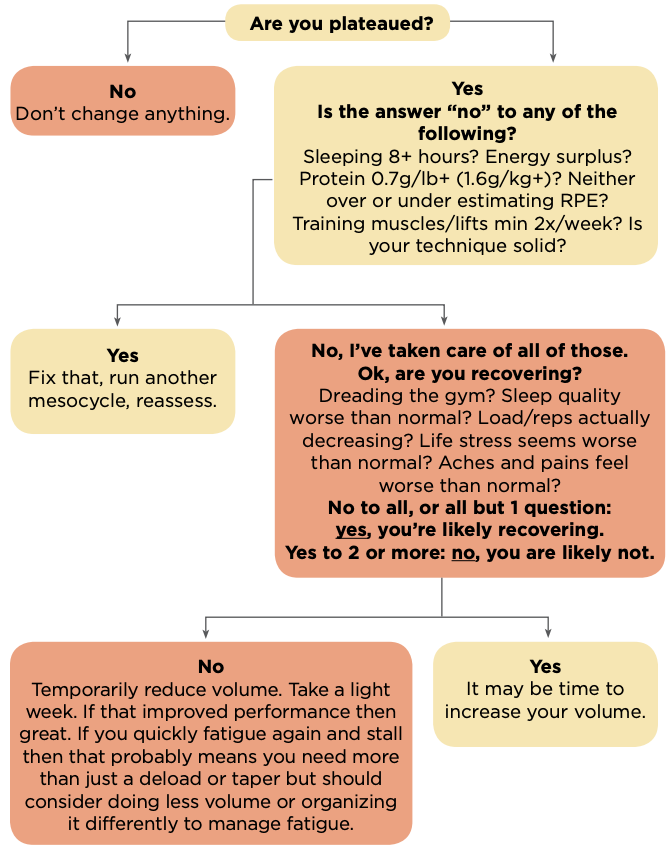
How to know when do you need a deload.
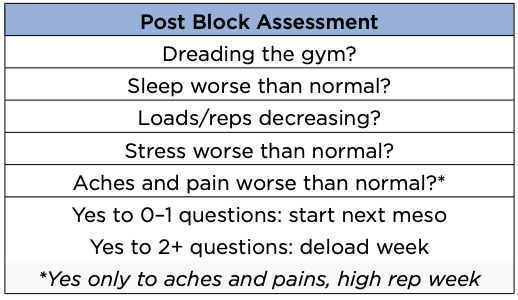
Progression flowchart
Linear Periodization
Linear progression is increasing the weight each session and reducing the reps over a few sessions as described below:
| Session | Weight | Reps | RPE | Notes |
|---|---|---|---|---|
| 1 | 100 | 8, 8, 8 | 8 | |
| 2 | 101 | 7, 7, 7 | 8 | |
| 3 | 102 | 6, 6, 6 | 8 | |
| 4 | 100 | 6, 6 | 5 | Deload |
| 5 | 101 | 8, 8, 8 | 8 | |
| 6 | 102 | 7, 7, 7 | 8 |
Double Progression
Linear progression can not really be used on isolation exercises as the increase in load as a percentage of total lifted weight is too high.
An example would be if you bicep curl 10kg and need to go up to 12.5kg then the increase would be 25%, which is impossible to do every week.
An example of double progression as seen here:
| Session | Weight | Reps | RPE | Notes |
|---|---|---|---|---|
| 1 | 15 | 14, 13, 12 | 8 | |
| 2 | 15 | 14, 14, 12 | 8 | |
| 3 | 15 | 14, 14, 13 | 8 | |
| 4 | 15 | 12, 12 | 5 | Deload |
| 5 | 15 | 15, 15, 14 | 8 | |
| 6 | 15 | 15, 15, 15 | 8 | |
| 7 | 17.5 | 13, 12, 12 | 8 |
Block Periodization
In block periodization we break the type of exercise into blocks as follows
Accumulation Block (Hypertrophy Focus)
| Session | Weight | Reps | RPE | Notes |
|---|---|---|---|---|
| 1 | 100 | 10, 10, 10 | 6 | Establish baseline |
| 2 | 100 | 10, 10, 10, 10 | 7 | Add volume |
| 3 | 102 | 8, 8, 8, 8 | 7 | Slight load increase |
| 4 | 102 | 8, 8, 8, 8, 8 | 8 | Volume progression |
| 5 | 105 | 6, 6, 6, 6, 6 | 8 | Heavier, controlled |
| 6 | 105 | 6, 6, 6, 6, 6, 6 | 8 | Peak volume |
Intensification Block (Strength Focus)
| Session | Weight | Reps | RPE | Notes |
|---|---|---|---|---|
| 1 | 110 | 6, 6, 6 | 8.5 | Transition to heavier |
| 2 | 112 | 5, 5, 5 | 9 | Strength emphasis |
| 3 | 115 | 4, 4, 4 | 9–9.5 | Near maximal effort |
| 4 | 118 | 3, 3, 3 | 9.5 | Peak strength focus |
Realization Block – Taper Week
| Session | Weight | Reps | RPE | Notes |
|---|---|---|---|---|
| 1 | 115 | 3, 3 | 7 | Maintain neural stimulus |
| 2 | 115 | 2, 2 | 7–8 | Reduced fatigue |
| 3 | 118 | 2 | 8 | Priming session |
Realization Block – Testing Week (Hypertrophy)
| Session | Weight | Reps | RPE | Notes |
|---|---|---|---|---|
| 1 | 110 | AMRAP | 9–10 | Volume capacity test |
| 2 | 100 | AMRAP | 9 | Secondary assessment |
Tapering For competitive bodybuilders
Bodybuilding competition is all about appearance, thus the authors suggestions are more geared towards nutrition, they do however give some comments as follow:
- Keep your exercises, split, and number of sets the same but perform 8–20 reps on all training days.
- Keep RPE at 6–8.5, avoid performing movements that cause soreness (new movements or those with heavy eccentrics at long muscle lengths, like RDLs).
- On the final one to two days before competition, you can do a full body pump up routine similar to what you would do the day of competition, but RPE should reach no higher than 6 and this should only take 30 minutes.
Level 4: Exercise Selection
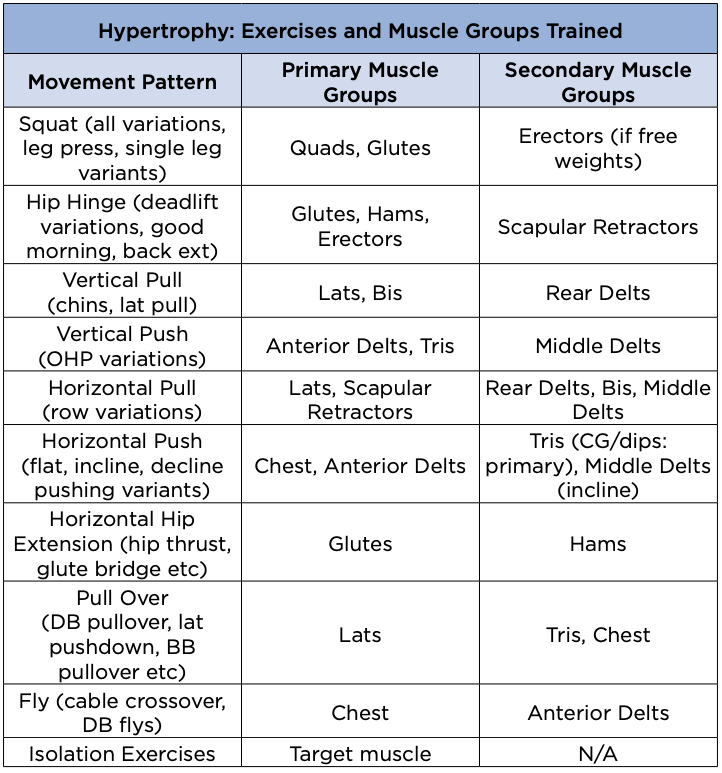
Ensure you take secondary muscle involvement into consideration when doing total volume calculations.
Chapter Key Takeaway
| Exercise Selection Guidelines |
|---|
| 1–2 compound exercises for each major muscle group. 1–3 isolation exercises for each muscle group. |
Level 5: Rest Periods
This chapter goes into the science or lack of consensus around what is the optimal amount of time to rest between sets, the answer seems to be: rest until you are ready.
The longer version:
- For smaller muscle groups rest about 1.5 min
- For compound movements rest about 2.5min
Level 6: Lifting Tempo
In this chapter, the author discusses concentric and eccentric muscle action, he notes we are stronger on the eccentric part, and as such if we really want to train for hypertrophy we should have a higher load on the eccentric part which requires specialized equipment, which almost no commercial gym has.
My Recommendation
I ❤️ this book and highly recommend picking it up. I really appreciated the extensive study references, which suggest that the recommendations are grounded in the currently available science. The authors are careful to note that these are not hard and fast rules, but evidence-based guidelines.
This book stands out because it bridges practical coaching advice with actual research. It avoids dogma and instead presents training principles as recommendations rooted in evidence.
For beginners, the early levels alone are enough to build years of progress. For intermediates and advanced lifters, the later sections on progression and periodization provide a clear framework for long-term development.
If you’re serious about training — especially hypertrophy — this book belongs on your shelf.
Now go hit the gym 💪!!
Links
Progression - This is a website I found with a lot of the information found in the book.