
Book Review – The Muscle & Strength Pyramid - Nutrition Second Edition
Overview
Finally finished this gem. I meant to wrap it up within a month of starting… but I dropped the ball ⚽.
As mentioned in another post, I’m competing at Aoteroa Strength Alliance Rosetown Posedown on the 6th June 2026, and this book accompanied me through the torture we call cardio 😆.
I have already reviewed its companion book, The Muscle and Strength Pyramid – Training 2. If you haven’t read that review yet, go check it out.
Here’s my summary of The Muscle & Strength Pyramid — Nutrition, Second Edition.
The Muscle and Strength Pyramid - Nutrition
Similarly to its companion book, the authors aim to bring clarity to a field that is often rooted in misconception and oversimplification.
As with the Training book, the core ideas can largely be captured in a single image:
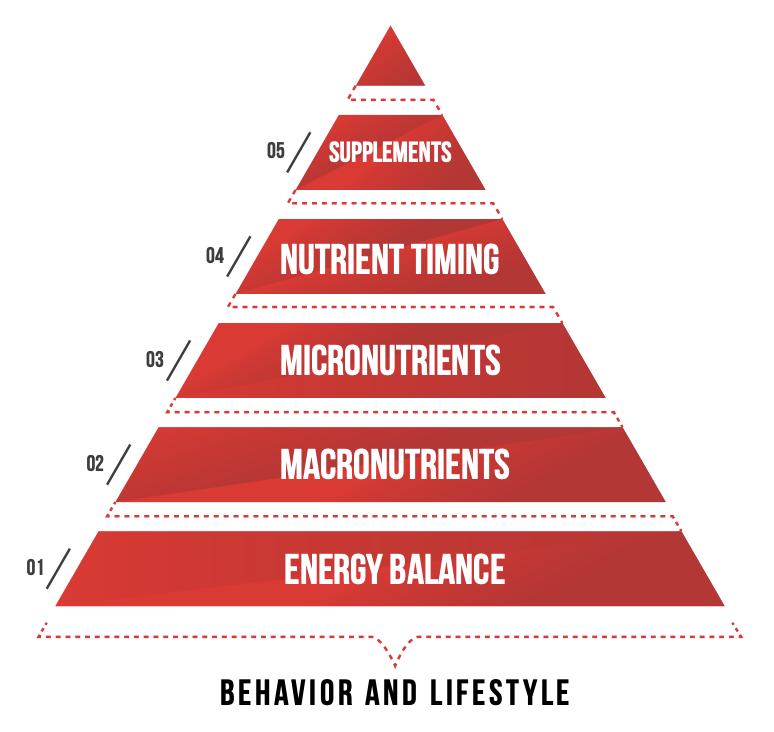
If you are serious about managing your weight and improving your physique, you need to start at the bottom of the pyramid. That’s where most of the progress is made.
As you move up, you encounter diminishing returns. The details matter — but only after the fundamentals are in place.
Mindset and Materials
This section covers what I would argue are two of the most important aspects of any weight-loss or physique journey. In some ways, these may be even more important than the objective pyramid itself.
The Mental Side
The authors emphasize the psychological component heavily — and rightly so. Without adherence, the entire pyramid collapses.
To track or not to track?
Throughout the book, the authors consistently distinguish between two groups:
- Recreational trainees who want to improve their physique.
- Competitive athletes in bodybuilding or weight-class sports.
The level of dietary precision required between these groups is worlds apart.
If you’re not stepping on stage or making weight for competition, you may not need to track calories, macros, and bodyweight obsessively.
Rigid Meal Plans
The authors warn against overly rigid meal plans because they can create binary thinking:
That said, I do think structured planning can be extremely useful — especially when calories are tight. Personally, I find it difficult to hit targets consistently “on the run.”
Later in the book, they discuss relying more on internal satiety signals — something I’m currently experimenting with.
The “Good Food vs. Bad Food” Approach
This is one of the most common traps in nutrition.
Binary thinking:
- Don’t eat X.
- Only eat Y.
How to Track Body Weight
But bodyweight fluctuates.
Single weigh-ins are noisy.
If you’re not averaging your weight over 7 days, you’re basically reacting to water and glycogen, not actual progress.
Level 1: Energy Balance
Everything starts here.
If the bottom of the pyramid isn’t right, nothing above it matters.
Maintenance Calories
Before losing or gaining weight, you first need to know roughly how much food maintains your current body weight.
The popular approach is to plug your stats into an online calculator. That’s fine as a starting point — but it’s highly individual and often inaccurate.
The authors prefer a more practical method: Track your calorie intake and daily bodyweight for two weeks.
At the end of that period, you might see something like this:
| Week1 | Week2 |
|---|---|
| 141.7 | 141.8 |
| 142.1 | 142.2 |
| 142.7 | 143.0 |
| 141.7 | 141.7 |
| 142.5 | 142.5 |
| 141.9 | 142.8 |
| 142.1 | 142.0 |
| Average ~142.1 | Average ~142.3 |
That small increase tells you something important: You are likely in a slight surplus.
If bodyweight increased by ~0.2 kg over 7 days:
- 1 kg of fat ≈ 7000 kcal
- 0.2 kg ≈ 1400 kcal surplus
- 1400 kcal ÷ 7 days ≈ 200 kcal/day above maintenance
This isn’t perfect science — but it’s good enough to guide decisions.
Gaining or Cutting?
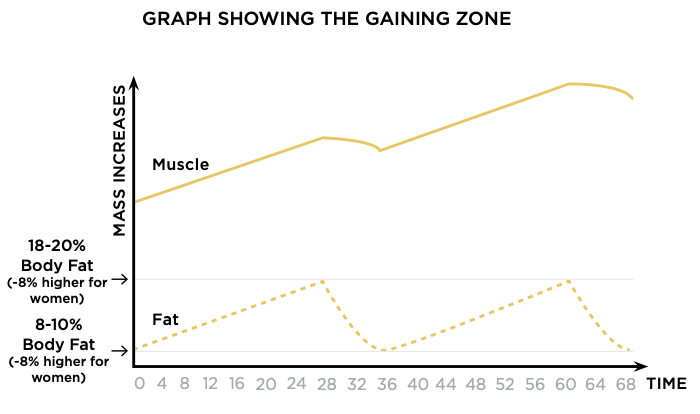
This visual illustrates the principle well: Stay within a reasonable body-fat range while progressing.
Appropriate Rates of Weight Loss
For a 90 kg individual:
- 0.5–0.9 kg per week
Personally, I respond better to a slower cut. It’s easier to adhere to and I’m not constantly hungry.
The authors also make an important point:
Appropriate Rates of Weight Gain
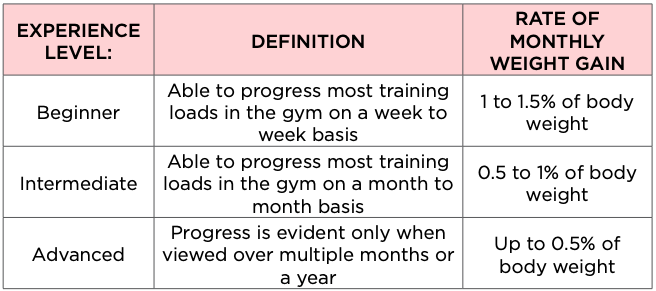
The more advanced you are, the slower you should gain weight.
Beginners can gain faster with a higher proportion of muscle. Advanced lifters? Most rapid weight gain becomes fat.
Energy Availability
This is where things get interesting.
There are rough lower thresholds:
- Women: ~30 kcal/kg/LBM
- Men: ~25 kcal/kg/LBM
But the authors emphasize symptoms over strict numbers.
Warning signs of low energy availability include:
- Loss of menstrual cycle
- Persistent food focus
- Frequent illness
- Poor mood
- Inability to progress
- Loss of libido
- Hormone markers outside reference ranges
Leanness has a cost.
Level 2: Macronutrients
Macros — as they’re commonly called — refer to protein, carbohydrates, and fats.
The authors briefly mention alcohol as a fourth macronutrient (since it contains calories), but realistically, it’s not one you want to rely on often — especially in a physique-focused context.
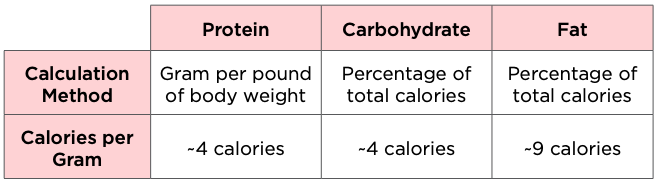
Fat Loss Phase
Protein Intake
This section is fascinating.
The authors walk through multiple studies to arrive at a practical recommendation for protein intake while dieting — where preserving muscle mass becomes critical.
That is higher than most general-population recommendations — but context matters.
When calories are restricted:
- Muscle retention becomes harder.
- Hunger increases.
- Recovery becomes more fragile.
Higher protein helps buffer those pressures.
Carbs and Fats Intake
The authors prioritize muscle retention in this order:
The following are recommended values for fats and carbs:
As for minimum values, these minimums act as guardrails.
Below them, hormonal function, performance, and adherence can start to degrade.
Gaining/Loosing Summary
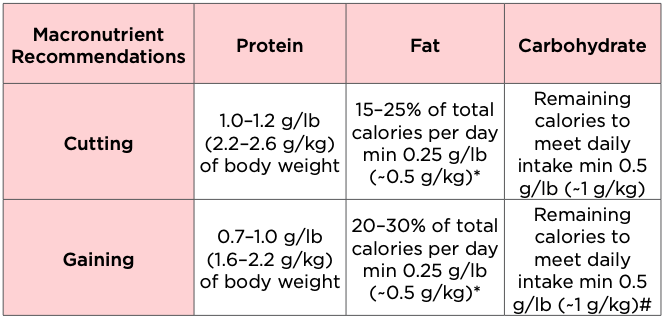
The takeaway is fairly simple:
- Protein stays relatively high.
- Fat is kept within functional minimums.
- Carbohydrates fill the remaining calorie allocation depending on goal.
Level 3: Micronutrient and Water
Micronutrients refer to vitamins and minerals. If you are deficient in them, it can impact things like:
- Metabolism
- Strength
- Bone health
The authors really drive home the point that aggressively excluding food groups — especially while dieting — can backfire. If you live on nothing but chicken and rice 😆, you may very well end up deficient in certain vitamins and minerals over time.
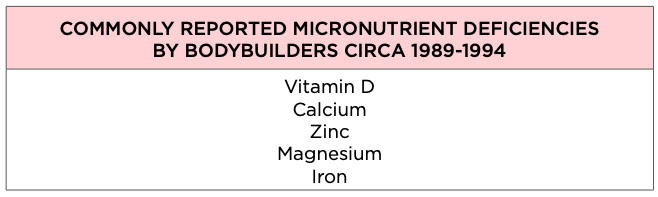
They recommend the following general approach:
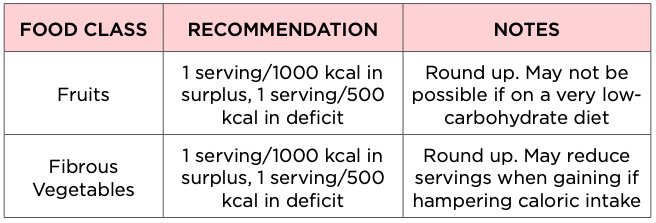
So yes… your mom was right about eating your fruits and vegetables 😆.
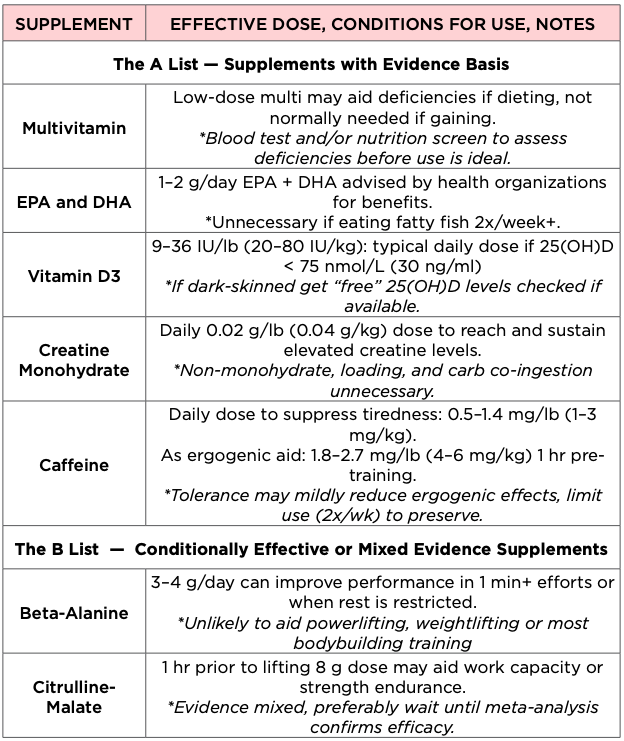
Supplements
The stack I have been experimenting with tends to include:
- Vitamin D – I am basically a vampire and avoid the sun as much as possible.
- Magnesium – Seems to help with sleep, though I am still experimenting here.
- Fish oil – Based on my reading this appears beneficial, but third-party testing is a must. This is not something to cheap out on.
Hydration
I also couldn’t pass up the opportunity to include the authors’ urine color guide.
- 1 is what you want to aim for.
- 8 means: drink water. Immediately.

Level 4: Nutrient Timing and Frequency
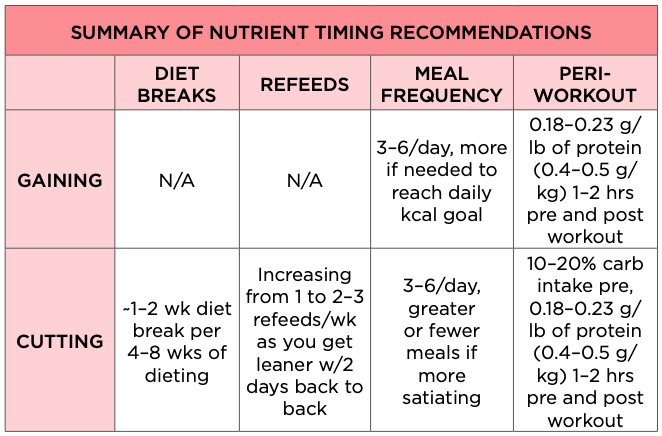
Diet breaks
“Breaking down” in this context usually means the psychological crash — bingeing, excessive hunger, irritability, and adherence falling apart.
Stalling of fat loss is also normal and well described:
In simple terms: the longer you diet, the more your body adapts.
How to implement a diet break
Diet breaks are generally recommended during extended cutting phases and typically last 1–2 weeks.
Refeeds
Refeeds are shorter-term increases in calories — usually 24 hours, sometimes 48 hours.
Single-day refeeds are typically brought up toward maintenance calories for one day.
Multi-day refeeds may make more sense the leaner you get:
Of course, calories don’t disappear. If you refeed, you may need to slightly reduce intake on other days to maintain your weekly deficit.
Meal frequency
Personally, while cutting, I tend to divide my calories into:
- Breakfast
- Pre-lunch
- Lunch
- Pre-dinner
- Dinner
I notice I start looking forward to the next meal about an hour before it arrives — which probably says more about dieting psychology than metabolism 😆.
I haven’t experimented much with dropping to three meals per day, but based on the evidence, it likely wouldn’t drastically change body composition outcomes.
Peri-Workout Nutrition
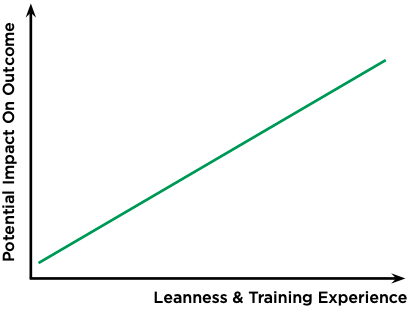
This image summarizes it well: nutrient timing becomes more relevant the leaner you get, but it’s rarely the main driver of progress.
For dieting individuals, the authors recommend:
Chapter Summary
Level 5: Supplementation
That line hits hard — and it’s probably true more often than we’d like to admit.
Third-party testing is the gold standard and should be the aim whenever possible. Unfortunately, that’s not always easy to verify — especially in New Zealand, where access to clearly third-party-tested supplements (particularly vitamins and minerals) can be limited.
In practice, I tend to stick with slightly more reputable and often more expensive brands — but let’s be honest: no company is above scrutiny.
The authors also warn strongly against:
- Proprietary blends (where you don’t know the actual dose of each ingredient)
- Newly hyped supplements with limited human data
- Anything relying more on testimonials than trials
If you don’t know what you’re taking, or how much you’re taking, you’re essentially trusting marketing over measurement.
Chapter Summary
Making Adjustments and Measuring Progress
This chapter dives into how to measure whether you are actually progressing toward your goal — and, just as importantly, the pitfalls of each method.
Body-Fat Testing
DEXA
Even worse:
In other words, unless conditions are tightly controlled, DEXA can give you numbers that look precise but vary widely in practice.
Skinfold
The key takeaway: consistency matters more than the method.
A good skinfold assessor used consistently may be more useful than an inconsistent DEXA scan.
Scale Weight Change
Scale weight should be assessed using rolling averages (for example, a 7-day average), as daily fluctuations are normal due to:
- Water retention
- Sodium intake
- Glycogen levels
- Inflammation from training
Personally, I’ve noticed I tend to weigh more after a hard leg session the previous day. I also seem to retain more water after higher-carb meals — especially rice.
Visual Assessment
Recently, after speaking to one of the judges at a show, they mentioned something that stuck with me:
Trophies are not awarded to the person with the lowest body-fat percentage or the lowest number on the scale.
They’re awarded based on how you look on stage.
That alone makes visual assessment an essential tool — especially in physique sports. The scale measures quantity. Visual assessment reflects quality.
That said, there’s a catch.
The leaner I get, the lower my energy tends to drop — and the more my brain seems to play games with me. It becomes very easy to think:
- “I’m not lean enough.”
- “I need to push harder.”
- “Just a little more.”
Be warned — you might be leaner than you think.
That’s why visual assessment works best when:
- Compared against previous photos
- Taken under consistent lighting and conditions
- And ideally evaluated by someone more objective than yourself
Peaking for Competition
Carb Loading
Carb loading is described as:
The idea is simple: more glycogen stored in muscle → fuller appearance on stage.
However, the authors warn that “spillover” (appearing smooth or watery) becomes much easier toward the end of prep because glycogen storage capacity adapts downward:
In other words: your “tank” shrinks during prolonged dieting.
As such, carb loading should be relative to the carbohydrate intake you were consuming during prep — not some arbitrary large number.
The Ideal Scenario
The authors suggest that the ideal way to peak is not aggressive manipulation, but early preparation:
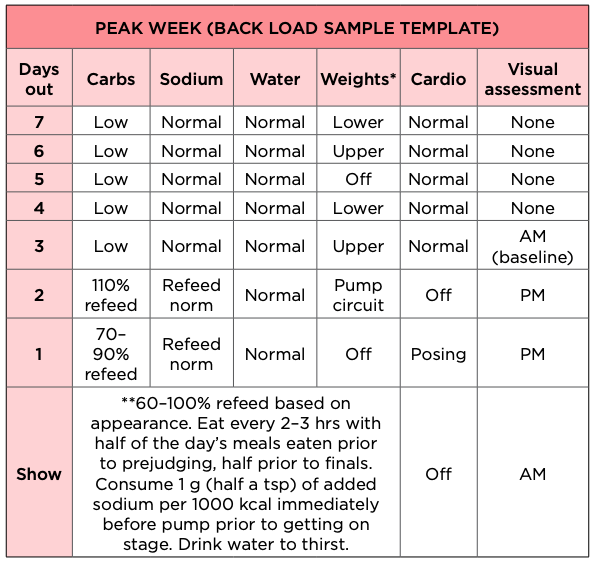
Carbohydrate Back Loading
This strategy revolves around learning how your physique responds to refeeds:
Some people look best:
- The same day as the refeed
- One day after
- Two days after
The goal is to identify your timing and align that with show day.
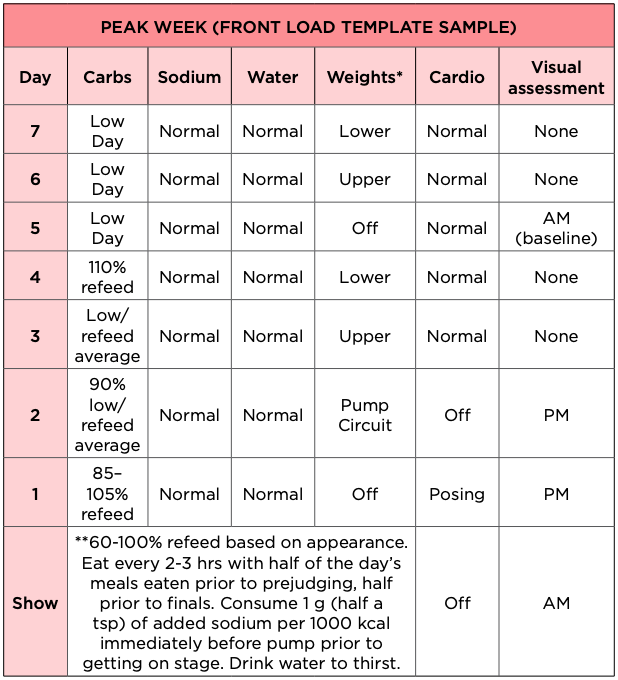
Carbohydrate Front Loading
Front loading attempts to create two carb peaks:
This is more advanced and likely best reserved for experienced competitors.
Water and Electrolyte Manipulation
The authors strongly caution against this — especially for natural competitors:
Sodium and water are required for fullness.
Cutting them often:
- Makes competitors feel terrible
- Flattens them
- Or worsens their appearance
Training Considerations for Peak Week
The recommendation is surprisingly conservative:
- Keep training volume (number of sets) the same.
- Don’t train to failure, leave at least a rep or two in the tank — don’t get caught up thinking you have to do depletion workouts. Unless you’re eating up into your show, trust me, you’re already depleted if you got shredded.
- Shift your rep ranges to the 8–20 rep range to keep things just a tad more glycolytic.
- Don’t introduce any new exercises and don’t perform any movements heavily loaded in an eccentric stretched position, as they cause more soreness than others. (For example, avoid Romanian deadlifts, good mornings, or full range heavy dumbbell flyes.)
- Perform a pump-up session two days out to keep carbs directed towards your muscles, but still allowing active recovery for any lingering muscle soreness or damage.
Peak week is about managing stress and minimizing variables — not introducing heroic new strategies.
Chapter Summary
The Recovery Diet
Coming Out of Contest Prep
The authors also discuss how to transition out of contest prep — which is arguably just as important as the prep itself.
Traditionally, many competitors use a reverse diet. In an ideal world, this involves slowly increasing calorie intake over time so that you end up leaner at higher calories — theoretically setting yourself up to gain muscle with minimal fat gain.
The problem? In practice, reverse dieting can mean you’re still effectively dieting even after the show is over.
The Recovery Diet Approach
Instead of slowly inching calories up, the authors recommend something they call a recovery diet.
The key ideas:
- Allow a few untracked meals, but keep them reasonably sized — avoid binge behavior.
- Aim to gain around 5–10% above contest weight within the next 4–8 weeks.
- Increase calories more aggressively (roughly +400 to +1000 kcal) while reducing cardio.
The goal here isn’t to stay stage-lean.
My Recommendation
Like its companion book, I ❤️ this one and highly recommend picking it up. What I appreciate most is the extensive referencing — the recommendations are clearly grounded in the best available research. The authors are also careful to remind the reader that these are guidelines, not rigid rules.
What I’ve covered here only scratches the surface. Each topic is discussed in depth, with references to the literature and clear distinctions between those aiming to get stage-lean and those who simply want to be lean, healthy, and sustainable.
If you’re serious about managing your body composition — whether cutting, gaining, or maintaining — this book absolutely deserves a spot on your shelf.
Now put down that burger 🍔… or at least make sure it fits your calories!!
Links
- Nutrition - This is a website I found with a lot of the information found in the book.
- Macro Calculator
- Bulk Macros Adjustment
- The Nutrition Pyramid Calculation Aid